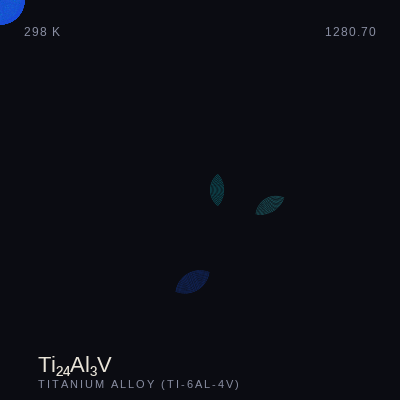
Titanium alloy (Ti-6Al-4V)
Aircraft frames and hip replacements: the hexagonal close-packed lattice of the alloy that carries both.
 Elements
Gifts · engineers and materials people
Engineers buy things that are correct. These pieces are computed from crystallographic and molecular data — titanium's hexagonal close packing, a turbine blade grown as a single crystal, niobium-titanium drawn as one coherent wave at 4 K and as an ordinary metal above 9 K. Nothing is stylised, nothing is random, and the temperature is part of the subject rather than a caption.
Titanium alloy (Ti-6Al-4V)
Aircraft frames and hip replacements: the hexagonal close-packed lattice of the alloy that carries both.
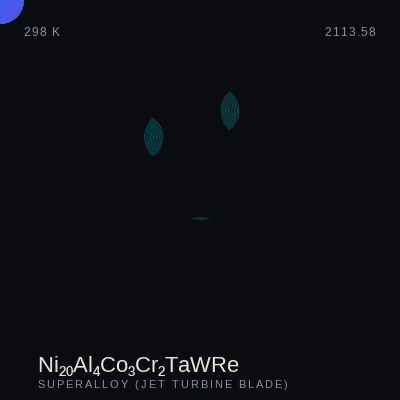
Superalloy (jet turbine blade)
A single crystal by design — no grain boundaries left to creep at temperature.
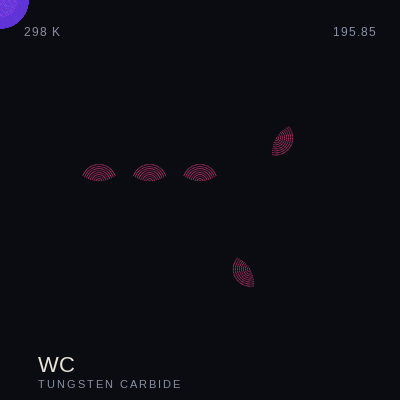
Tungsten carbide
The hardest common material, drawn as its tungsten-carbon lattice.
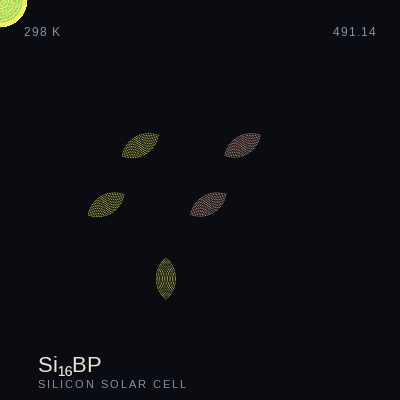
Silicon solar cell
Boron on one side, phosphorus on the other: a junction you can see.
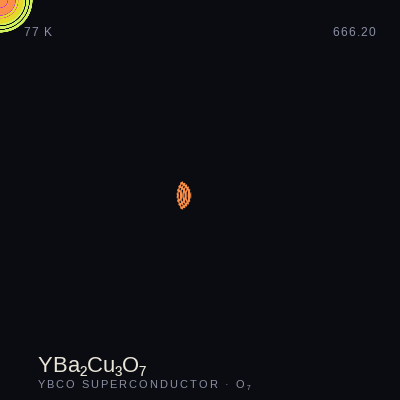
YBCO superconductor · O₇
The cuprate that superconducts above liquid-nitrogen temperature.

MRI magnet · superconducting
Niobium-titanium at 4 K, drawn as one coherent wave rather than atoms in places.

MRI magnet · normal
The same coil above 9 K: an ordinary metal. The pair is a critical temperature, stated in pictures.

Fusion magnet
Niobium-tin holding a star's worth of plasma in a bottle.
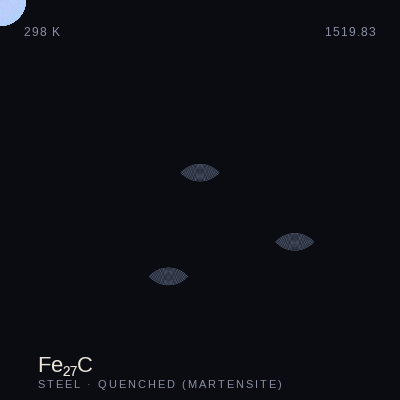
Steel · quenched (martensite)
Carbon trapped mid-transformation — the reason quenched steel is hard.
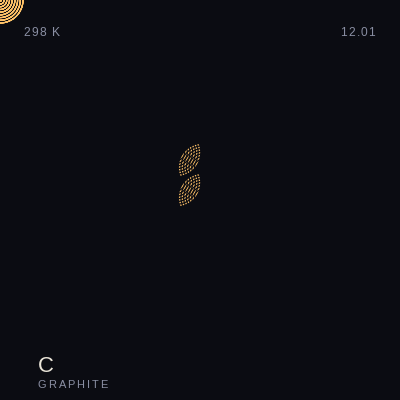
Graphite
The lubricant that is also one of the stiffest planar bonds in nature.
Superconducting and normal, quenched and annealed, oxygenated and deoxygenated: the collection draws state changes as pairs, because a phase transition is a difference and a difference needs two pictures. All 35 technology pieces →